
Caltrain’s Overwrought Doomsday Scenario
A Crisis Manufactured from Years of Bad Decisions

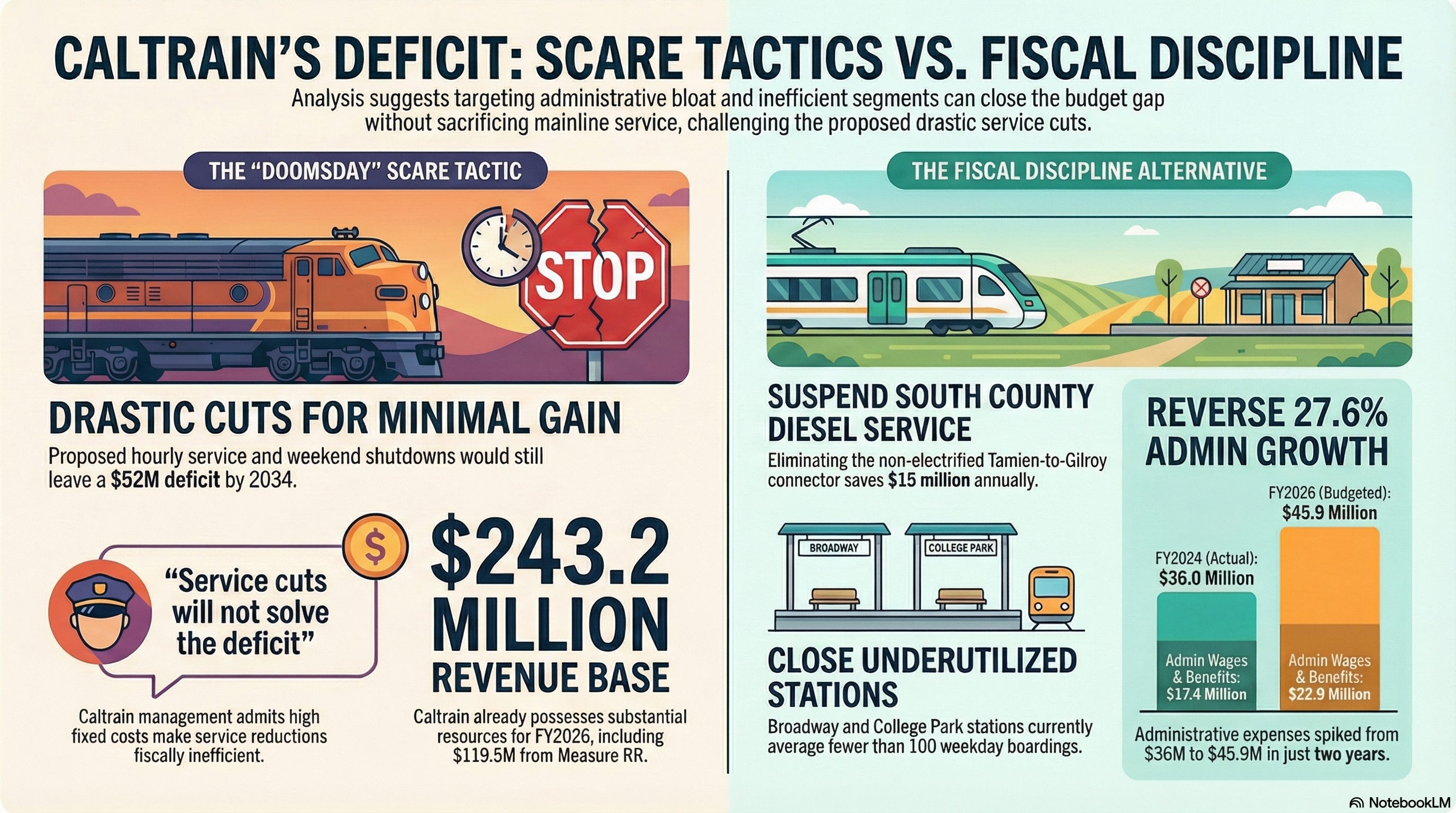
When Caltrain’s board convened an April 2 budget workshop to present what it calls a “no external funding scenario,” management described a bleak future: hourly trains, no weekend service, shutdown at 9 p.m., and a third of stations closed. The subtext was clear -- vote for the SB 63 half-cent regional sales tax in November, or suffer the consequences. But a review of Caltrain’s own FY2026 adopted budget alongside publicly available ridership data suggests that an agency genuinely committed to fiscal discipline could preserve meaningful service without a new tax. What Caltrain has produced instead is a pressure campaign disguised as a budget plan.
The budget itself shows grand total revenue of $243.2 million in FY2026, including $119.5 million from Measure RR, $35.7 million in operating grants, and $45.3 million in fare revenue. That is a substantial resource base. Caltrain’s own presentation acknowledges that “service cuts will not solve the structural deficit” because of “high fixed costs, low marginal savings” -- which makes the proposed reduction to hourly service difficult to justify on fiscal grounds. Drastic cuts would suppress ridership and fare revenue, accelerating - rather than closing - the gap. Even under the full Doomsday scenario, Caltrain would still face a $52 million annual deficit in 2034. The cuts are not a solution; they are a scare tactic.
A more defensible restructuring would target costs where the return on spending is lowest. The most obvious candidate is the diesel South County connector between Tamien and Gilroy. Caltrain does not own that Union Pacific corridor, cannot electrify it, and must maintain a separate diesel fleet to operate it. Gilroy City Councilmember Zach Hilton, who sits on both the VTA Policy Advisory Committee and Caltrain’s Local Policy Maker Group and has tracked these numbers carefully, reports that the FY2026 cost of South County connector service is $15 million for five stations.
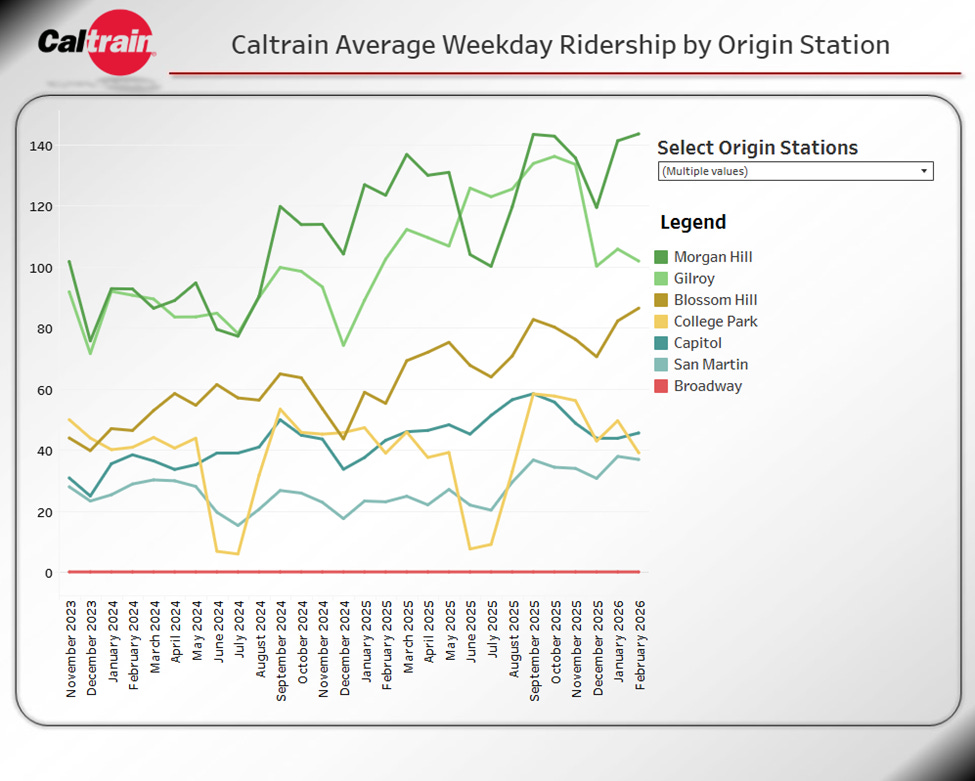
Caltrain’s own ridership dashboard shows that even after a post-electrification surge, South County stations remain at the bottom of the system. VTA’s Route 68 and Rapid 568 already serve this corridor daily and would absorb displaced riders. Suspending the diesel connector would save $15 million annually while affecting only a few hundred weekday commuters who have alternative service available.
Two mainline stations are also strong candidates for closure. The same ridership dashboard shows Broadway station and College Park generating less than 100 boardings on an average weekday.
Caltrain’s administrative costs also require attention: its FY2026 budget reveals spending growth that is difficult to reconcile with an agency claiming fiscal emergency. Total administrative expense has grown from $36.0 million actual in FY2024 to $45.9 million budgeted in FY2026, a 27.6 percent increase in two years. Administrative wages and benefits alone climbed from $17.4 million to $22.9 million, up 31.8 percent. Combined with the South County suspension, Caltrain could plausibly close $20 million or more of its projected gap before cutting a single mainline train.
Caltrain’s structural deficit is real, and additional long-term revenue may ultimately be necessary. But transit agencies that wish to make a credible case for new public money should first demonstrate that they have exhausted cost control options. Presenting the scariest possible service scenario while administrative costs climb 28 percent in two years is not fiscal stewardship -- it is extortion. The November ballot measure deserves to be evaluated on its own merits, not stampeded through on the strength of avoidable threats.
Marc Joffe is Director of Finance for SHIFT Bay Area
How many tax/bond measures have been passed too feed cash into Caltrain to keep it a float prior to this attempt? Can Caltrain keep pace with the speed at which California is taxing, debating to tax, and in committee to tax it's citizens? We are getting pulled from all sides and an agency that is poorly managed and bleeding money to the point of taxing the Bay Area for it is a scary thought
The only work public transit systems should be doing is to serve the customers they have now with their existing system. All future planning for expansions should cease until the deficit problems are solved.